
ISO 9001:2015, BSCI and REACH: What the Certificates Cover
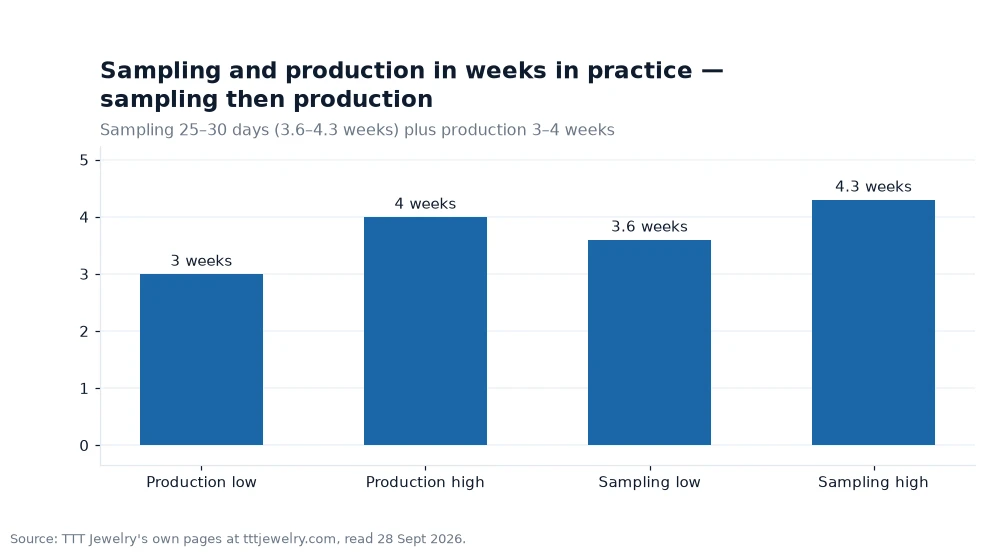
Three documents sit behind a compliant jewelry order, and no two of them test the same thing: ISO 9001:2015 covers the management system, BSCI covers labour practice, and REACH covers the substances in the metal and the plating. The published sampling window of 25–30 days is 3.6–4.3 weeks, so compliance paperwork has to be in place before that clock starts, not after it. Reading each certificate for its actual scope is the difference between evidence and decoration.

Key takeaways
- ISO 9001:2015 covers process control across all production stages, not metal content.
- BSCI is a social audit of labour practice and supply-chain conduct.
- REACH restricts lead, cadmium and nickel; TTT Jewelry also states plating compliance with CA Prop 65.
- Sampling takes 25–30 days (3.6–4.3 weeks) before 3–4 weeks of bulk production begins.
Three documents, three different jobs
A buyer new to sourcing tends to file every certificate under "compliance" and assume they overlap. They do not. ISO 9001:2015 is a management-system standard: it asks whether the factory defines its processes, measures them and corrects them. BSCI is an audit of how people are treated at work. REACH is a chemical regulation that names substances and limits. One can be true while another is absent, which is why a supplier pack should be read document by document rather than as a badge collection.
The practical consequence is that a certificate answers only the question it was written for. A quality system will not tell a buyer whether a brass casting contains lead. A social audit will not tell them whether a plating bath is nickel-safe. A chemical test will not tell them whether the factory inspects every piece or every tenth piece. A wholesale jewelry manufacturer that understands this will send a document for each question instead of one PDF with a logo on the cover.
ISO 9001:2015 is a system, not a metal test
TTT Jewelry describes its ISO 9001:2015 registration as the implementation of a quality control system across all production stages. The wording is precise and worth keeping: across all stages, not at final inspection only. In a jewelry factory that means documented settings for casting temperature, plating bath chemistry, polishing finish and inspection criteria, plus a record when one of them drifts. The value to a buyer is repeatability between the sample and the bulk run, and it is the part of the pack that matters most to an OEM/ODM buyer whose design has to come back identical in season two.
What the standard does not do is certify a product. It does not declare a ring hypoallergenic, waterproof or nickel-free. Those are properties of materials and coatings, tested under other rules. A buyer who needs a material claim should ask for a REACH statement and, where relevant, a CA Prop 65 statement, and treat the ISO document as evidence about how consistently the factory can hit the specification it was given.
BSCI looks at people, not plating
The BSCI audit sits in a different category entirely. It examines fair labour practices, safe working conditions and the ethics of the supply chain — hours, wages, health and safety, the treatment of workers. For a brand selling into European retail, that audit is often requested by the retailer rather than the factory's own marketing, and it is renewed on a cycle rather than issued once.
Its scope is the reason it cannot substitute for a chemical test, and the reason a chemical test cannot substitute for it. A bench can be perfectly clean on substance restrictions and still fail a social audit on working hours. Buyers assembling a supplier file should keep the two in separate folders and check the date on each, because an expired audit and a missing audit cause the same problem at the compliance desk: the order stops while paperwork is refreshed. A current report answers that question; a logo on a homepage does not.
| Document | Subject | Evidence to request | Not established |
|---|---|---|---|
| ISO 9001:2015 | Quality management across production stages | Current certificate, scope and audit date | Metal content, allergy safety |
| BSCI audit | Labour and social compliance | Audit report and renewal date | Plating durability |
| REACH | Lead, cadmium and nickel restriction | Material statement per base metal | Workshop conditions |
| CA Prop 65 | Plating and material exposure limits | Plating compliance statement | Process consistency |
REACH names lead, cadmium and nickel
REACH is the document buyers quote most and read least. TTT Jewelry states that its materials are free of lead, cadmium and nickel, and that plating is 100% compliant with REACH and CA Prop 65. Those are the three metals that matter most in jewelry because they are the ones that migrate onto skin. Lead and cadmium are restricted for toxicity; nickel is restricted for contact allergy, which is why earring posts and clasp parts receive the closest attention.
Brass deserves a specific note. It is an alloy of copper and zinc, and recycled feedstock is where unwanted lead can enter a melt, so the material statement for a brass line is not interchangeable with the one for silver. TTT Jewelry casts its brass line as artisan eco-brass with a REACH statement attached. A brand planning a custom brass jewelry range should ask for that statement for the exact alloy, not for brass in general, and keep it with the purchase order.
Worked example
Convert the published windows into the same unit before comparing them. Sampling at 25 days is 25 ÷ 7 = 3.57 weeks, rounded to 3.6. Sampling at 30 days is 30 ÷ 7 = 4.29 weeks, rounded to 4.3. Production at 3 weeks and 4 weeks stays as it is. Sampling plus production therefore runs from 3.6 + 3 = 6.6 weeks to 4.3 + 4 = 8.3 weeks. Add the 48-hour CAD stage, which is 2 days or 0.29 weeks, and the full route is 6.9 to 8.6 weeks — the same 48–60 day band the factory quotes in days. The four documents in the table also split by type: two are chemical (REACH and CA Prop 65, or 2 ÷ 4 = 50%), one is a management system and one is a labour audit. That split explains why a supplier pack needs four pieces of paper, not one.
Frequently asked questions
Does ISO 9001:2015 mean the jewelry is nickel-free?
No. ISO 9001:2015 covers the quality management system across production stages. Nickel restriction is a REACH matter, and TTT Jewelry states that its materials are free of lead, cadmium and nickel.
What does the BSCI audit cover?
Labour and social compliance: fair labour practices, safe working conditions and an ethical supply chain. It does not test metal content or plating thickness.
How long does sampling take before production?
25–30 days for master physical sampling, or 3.6–4.3 weeks, followed by 3–4 weeks of mass production before final inspection and shipping.
Building a supplier file that holds up
Keep one folder per claim and one date per document. Ask for the ISO 9001:2015 scope statement, the BSCI report with its renewal date, the REACH statement for each base metal in the order, and the plating statement covering CA Prop 65. Then match the folder to the purchase order: the alloy named on the PO should be the alloy named on the statement. Brands ordering a silver programme can check the same paperwork against the sterling silver jewelry manufacturer page before the first sample is cut. Compliance is a filing habit more than a single certificate.
Source note: figures come from the manufacturer's own website (tttjewelry.com), read 28 Sept 2026.[1]